
Government of Alberta · Case Study
Sixty days from public announcement to portal launch.
Client
Government of Alberta
Role
Product Design Lead
Timeline
Nov 2022 – Jun 2023
Build
8 weeks
Program
$900M over six months
Platform
Public web portal and internal case manager tool
01 / The Promise
On November 22, 2022, the Government of Alberta announced the Affordability Action Plan. The announcement carried a commitment to a date: payments to vulnerable Albertans would begin within weeks.
The infrastructure to deliver them did not yet exist. No portal, no eligibility logic, no identity flow, no payment rails. A small cross-ministry team had sixty days to build all of it.
There is no MVP for a benefits program. The day the portal opens, real people show up with real urgency.
02 / The Problem
Building a benefits program isn't mechanically difficult. Building one with a public launch date, for over a million people, across separate ministry data systems, is a different category of problem.
01
Existing programs came first: AISH, Income Support, PDD, Alberta Seniors Benefit, and foster and kinship care. Then the public: households under $180,000 with children or seniors.
02
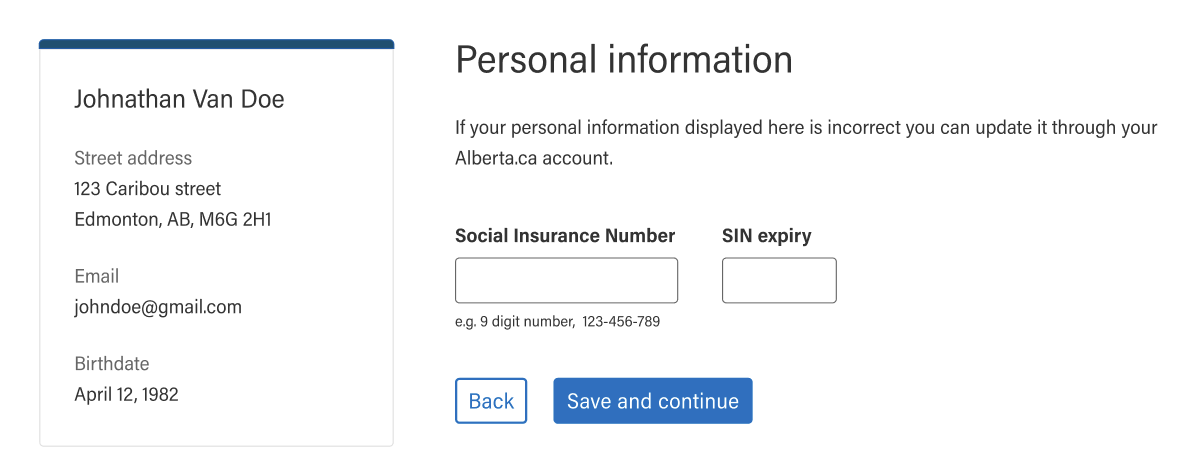
Public funds, real recipients, no duplicates. The team built on MyAlberta Digital ID and 2021 CRA tax data, so no one re-entered what the province already knew.
03
Monthly deposits through Canada's largest banks, with cheques as a fallback. Edge cases, like ageing out of eligibility, were modelled up front.
04
Not everyone could or would apply online. Day 1 had 50+ in-person locations, support in 100+ languages and two staffed help lines.
03 / The Approach
Before any screen was drawn, the team mapped the program end-to-end. Not the application. Not the dashboard. The entire benefit, from political announcement to final payment to post-program manual case management.
Multi-ministry workshops in FigJam surfaced where existing programs overlapped. The questions were structural: who does the province already know, who needs fresh authentication, and where do programs conflict?
That exercise produced two parallel intake paths, each designed against a different user model.
Path A / Auto-Enrollment
~300K
Pre-authenticated. Pre-enrolled. No application required. Portal load and input-error risk removed for the most vulnerable cohort before the doors opened.
Path B / Public Portal
~700K
Fresh attestation through MyAlberta Digital ID, cross-referenced against CRA tax data. Designed for the worst-case user, not the best-case one.
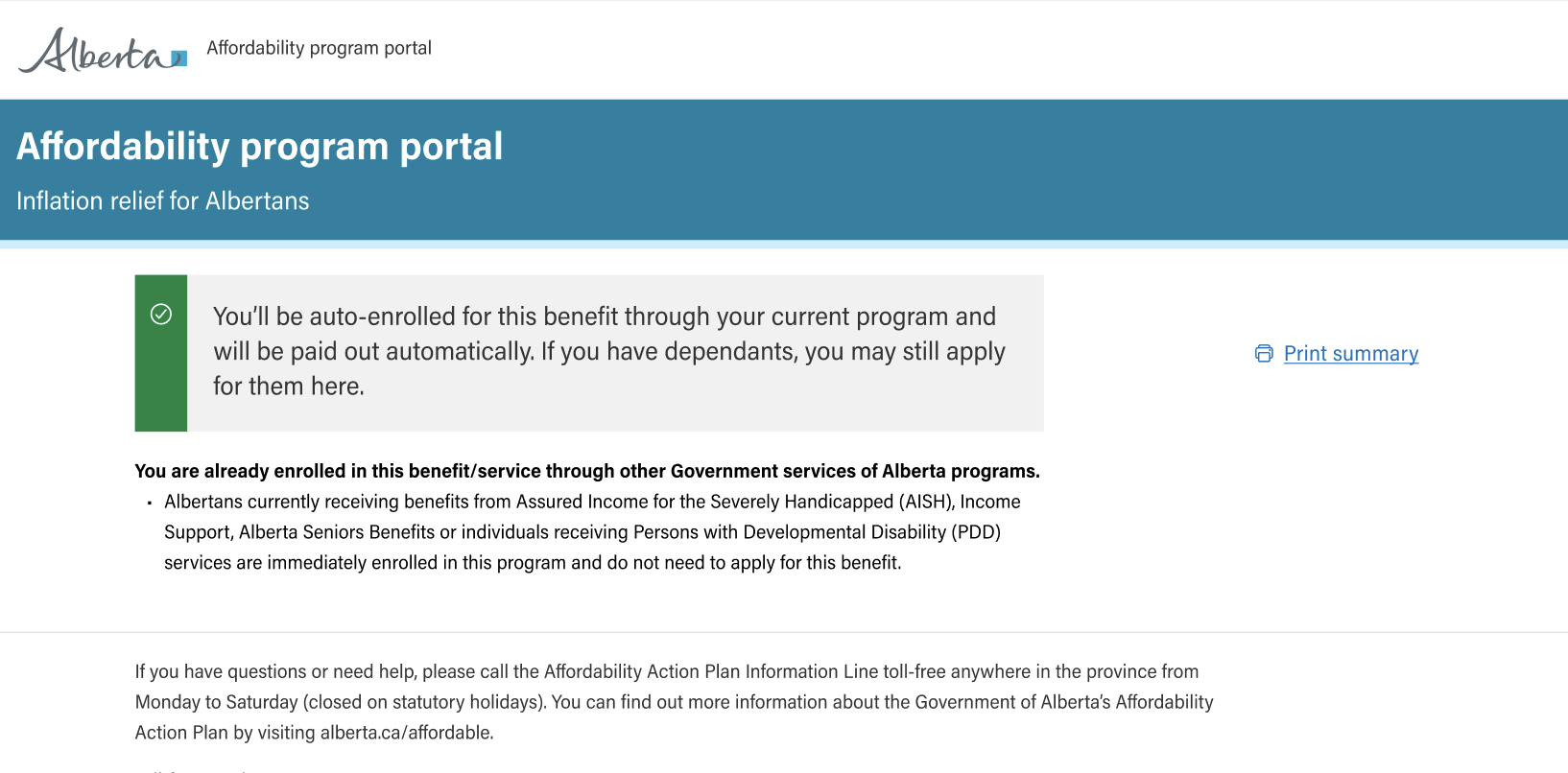
Both paths ended on the same payment rail. Behind them, an internal tool let case managers handle what automation couldn't, including cases that ran past the June 30 close.

04 / The Craft
Sixty days left no room for a clean waterfall. The team started with three product designers and finished with one, working in tight loops with developers.
01
Type, colour, spacing and component states all pointed to one master file. When legal needed one compliance line changed across the portal, it took an afternoon.
02
WCAG 2.1 shaped every component before visual design: focus and error states, content density, masking for sensitive fields.
03
Daily standups with engineers replaced handoff. Decisions lived in the working file. The file structure was the project history.
05 / Launch Day
On launch day, designers, developers and support staff watched the system together and shipped live front-end fixes to ease the call lines.
09:00 AM
Forty thousand applications already submitted
40,000
08:00 PM
Ninety-two thousand applications covering ~160,000 people, including 120,000 children
92,000
+24 HRS
Applications successfully processed for payment
140,000
Day-1 traffic beat projections. Slow confirmations and busy phone lines were fixed with front-end and copy changes, not a backend rebuild. The platform held.
Results
875K
Paid on the first scheduled payment day
1.2M+
Albertans enrolled by end of March 2023
140K
Applications processed for payment within 24 hours
The work upstream of launch day is the entire work.
06 / Reflection
01
Eligibility and identity logic are design surface, not back-end detail.
02
Some end up in Albertans' tax returns and case files.
03
Time-boxed, documented workshops left each ministry a decision record that outlived the program.
Project credits
Team
Cross-functional: service designers, digital architects, product designers, developers, multi-ministry stakeholders
Recognition
Public benefit delivered to ~1.2M Albertans against an eight-week build window
Sources & Public Reporting


